Showing posts with label poetix. Show all posts

Wednesday, January 12, 2011

A Conversation with Gary Sullivan

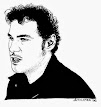
Gary Sullivan
rk, drawing by Gary Sullivan


This exchange took place over email between December 2007 and January 2008, and first appeared in MiPOesias. It’s about 3,700 words, or 8 printed pages long. Since it’s here for mostly archival purposes, I’ll just park the whole thing in one post.

RODNEY KOENEKE: Let’s start with endings. You write beautifully about the dead. The Introduction to How to Proceed in the Arts, which centers on the funeral for your friend Ramez Qureshi, and your Afterword to Daniel Davidson’s culture, are some of my favorite prose writings by you. (You’re also Davidson’s literary executor.)

The title of your Rain Taxi strip, “The New Life,” is a tip of the hat to Dante—who claimed to have seen the dead—but also refers to a near-death experience you had on a New York subway. Elsewhere #3 carries elegies to John Wieners, Jackson Mac Low, and Robert Creeley. Not to put too fine a point on it, your first book, Dead Man, opens with an epigraph from Maurice Blanchot’s Death Sentence.

I don’t think of you as an especially morbid or death-obsessed writer. How do death and the responsibilities of memory shape your approach to poetry?


GARY SULLIVAN: I don’t think I’m morbid, but then again I’m toying with an issue of Elsewhere devoted to images from Brooklyn’s Green-Wood Cemetery. I wrote Dead Man a couple of years after that subway fire you mentioned, so maybe there’s some connection. And, come to think of it, my first published poem was “Among the Living,” which ultimately wound up in Swoon.

I’ve long been obsessed with ideas about death, with cultural ideas surrounding it, and how those ideas turn up in ideas about writing—which accounts for my specific interest in the Blanchot. But this seems part of a larger obsession I’ve had with ideas about anything that we’re not capable of fully comprehending, or a general obsession with “otherness,” if that makes sense. Death is the ultimate “elsewhere.”

I don’t feel any particular responsibility to remember the dead; if I did, I’d be the kind of writer who’d grapple on some level with Irish history, with the famine, with the systematic decimation of the Irish language. I’d probably have worked at reading Joyce’s writings more thoroughly, especially Finnegans Wake, which has so much to do with death and memory, down to the level of etymology. I remember attempting to get through, around the time I was writing Dead Man, Frances Yates’ book on Giulio Camillo’s Memory Theater, but I just couldn’t do it.

But death, on some level or another, probably colors my writing post-subway fire, when I moved from San Francisco to Minneapolis. I wrote a short book of poetry around that time, Right in the Head, which had a lot of death in it—there’s a poem from it in How to Proceed in the Arts, “Wall of Sound,” which ends with the narrative I, in a cemetery, “pedaling away from the dead.”

That might have been a reference to Flann O’Brien’s The Third Policeman, which takes place after death, and has a lot of stuff going on about bicycles. It’s one of my all-time favorite books. It’s pretty hilarious, chock full of exotic theories (e.g., darkness = accretions of black air). Has anything ever been as exoticized as death?

Which makes me think of your own work, because it definitely seems to have come out of your own thinking about exoticizing, to some extent. Rouge State, especially, though also in Musee Mechanique. How much of the kinds of thinking that went into your scholarly book on I.A. Richards  winds up in your poetry?


RK: Rouge State was kind of the back weave of my dissertation, which turned out looking better hung in reverse. Both books were trying to puzzle out what to do with all this bad history that sticks around like fissile material—empires, exploitation, and the complicity of even its hippest critics in the larger habits of language and thought that enable it.

In retrospect, I think I was looking for the alternative of an “elsewhere”—like China was for Richards, or the Maharishi for the Beatles, or the “I” for Rimbaud—without really believing there is one. At the time, that seemed to leave two options: either flipping over well-meaning thinkers like Richards to expose the spotted underbelly, or sending up the whole shebang like Macy’s Day balloons. What would it mean “to run / the little India of ourselves / with a languorous bureaucracy?” At what point does the tree forget its seed?

I’m intrigued by your idea of death as the ultimate “elsewhere,” the last zone it’s OK to exoticize. Could you talk a little more about how you conceive of the Elsewhere? It’s the name of your ongoing comics serial, and your blog. It connects with your interests in Bollywood films, world musics, and that capacious global aesthetic you and Nada Gordon call “the Autré.” What does the concept of an “elsewhere” mean to you, and how do you think we get there?


GS: Two somewhat parallel events profoundly changed my relationship to self and other. The first was when I was in my 20s, living in San Francisco. I was very much attached to the idea of being Irish-American, and read almost nothing at one point but Samuel Beckett and Flann O’Brien. It got to the point where I was becoming biased against anything English. I briefly went out with a young Irish girl who claimed to have a boyfriend back home who was in the IRA.

Then, in 1989 or 90, when I was in my 20s, my paternal grandfather died. On his deathbed, he revealed to my father that he had been adopted, and that he’d run away from his adopted family at age 14, and took on the name Sullivan. His adopted family’s name was Shepard. But he had no idea who his real parents were.

Basically, I had been told that I was possibly the very thing I had been teaching myself to hate.

Then, in 1996, when I was living in Minnesota, I was randomly exposed to two things: one was a cassette tape, Haydi Söyle, by the Turkish arabesque superstar Ibrahim Tatlises; the other was the Bollywood film Khuda Gawah, which stars Amitabh Bachchan and Sridevi as Afghans.

I hated living in Minnesota, but out of a sense of self-preservation, since I was bankrupt and couldn’t move out of the state for several years, I just decided to fully immerse myself in the idea of being a Twin Cities person. I made a conscious attempt to embrace what was going on locally: so, for instance, I got really into the local bands, like Babes in Toyland, Trip Shakespeare, the Replacements.

I don’t know what possessed me to pick up the Ibrahim Tatlises cassette, other than that it was only two bucks. Tatlises’ voice was amazing, and even more so, the intense coloration of the music, which both rocked harder than anything I’d ever heard, but was also incredibly complex. I felt like I had been cheated out of hearing this all my life, and I blamed both myself, my intense identification with the local, what I imagined to be the limits of my “self,” and with the provinciality of the U.S. press, which pretty much ignored—still does—anything like this, anything not already being marketed to westerners.

My response to Khuda Gawah was similar. Why wasn’t Bollywood being talked about in the U.S.? Why was it always the products of filmmakers like the Coen brothers? And, most importantly, where could I get more of this stuff?

I was only in the Twin Cities for another year before moving to New York. But by the time I moved here, I had already shifted my attention away from the local. It was tough to do that in the Twin Cities, but here in New York, I had much more access. I started to discover that bodegas in different neighborhoods, mostly in the outer boroughs, sold CDs, cassettes, videos and DVDs from other places. So, walking down Steinway Street in Queens, for instance, you could get Bollywood films and filmi music in one hole-in-the-wall; further down the street you could get Arabic music at the Lebanese grocery; and a bit further, at a bodega run by a guy from Algeria, you could get a bunch of rai music.

Since then I’ve found a bodega in my neighborhood, Kensington, run by Albanians—and discovered Albanian pop, which runs the gamut from inconceivably fruitily awful to utterly jaw-shatteringly great. Or little video and music stores in Brooklyn’s Chinatown that sell DVDs from Hong Kong, mainland China, Taiwan, Thailand, Korea, and Japan—most with English subtitles.

What I’m drawn to musically has little to do with what is commonly understood as “world music”—a better name might be Bodega Pop. It’s the stuff that immigrant cultures have shipped over to the U.S., and it is completely different than what you find in the World or International sections at places like Tower (which went out of business) or Other Music or even Kim’s Video.

This is not to say that it’s more “authentic.” I don’t believe that word has much relevance regarding pop from any culture at this point.

That’s part of what Nada and I address in our talk, “The Autré,” which is a play on the words “outré” (outrageous) and “autre” (other). It was largely about 20th and 21st century artists around the world who have consistently explored and pushed the limits of “identity.”

We broke the talk down into five sections:

+ EXAGGERATION
+ MELODRAMA
+ REVERB (inappropriateness and cultural misprisions or “misprisons”)
+ CONTORTION/ PAROXYSMS
+ INGENUOUSNESS/ “INGENUOUSNESS”

Elsewhere—the blog and the comic book series—are both direct results of my own immersion, or semi-immersion, in all this stuff. Neither are answers—they’re questions. How does culture travel? What happens to it on the way? And what happens when cultural information is picked up by the “wrong” receiver?

Almost no-one I can think of in the poetry world is dealing with that last question at all. It’s there in Rouge State, just opening the book randomly:

Visigoth Kotex.
Arameaen E-Z Off.
Mesopotamian Speed Dialing.


Mycenaean Bingo Night.
Etruscan Live/Work lofts.
P-Celt Listerine.

Avar Avon.
Thracian Dental Tape.
Deutero-Malay Meatless Entrees.


Choctaw Quick-Mart.
Arapahoe Pool Supply.
Potawottamie Wok Emporium.

… and so on. I’m curious about what you’re working on now, Rodney. You did that great talk on Bollywood at New Yipes, which I think you called “Filmistan,” the idea being that Indian film culture is a whole other, specific, culture—not exactly Indian, though obviously related. That got me thinking an awful lot about culture, generally—or culture made manifest in cultural product.

American poetry culture isn’t America, it’s like, what? Poetrystan.

Why does Poetrystan seem so reluctant to address what seems to be a fact of everyday waking life—incoming signals not meant for us?


RK: Wait, so your grandfather made up a name, a paternity to go with it, then occupied that new identity till his deathbed. The authentic propped up by a secret.

I wonder how that moment with your grandfather shapes the tendency in your own work to occupy different voices, or to “write through” earlier texts. Dead Man is collaged from lines out of Mickey Spillane novels. You’ve created uproariously on-target descriptions of your friends’ work by inserting their names into Peter Schjeldahl’s New Yorker art reviews. The siphoning of voices and identities from the Internet in your recent plays comes to mind here, too, but so do your projects with other poets—the space you share with Nada Gordon, for instance, in Swoon, or the juxtaposition of her words (and O’Hara’s syntax) with your drawings in Elsewhere #2.

It seems to me that identity, authentic or otherwise, comes under serious pressure in your writing, but doesn’t get disappeared. Instead, it has to show it can bear the intrusion of the plural, or hold up somehow under the barrage of “signals not meant for us.”

Which is part of what that poem you opened to from Rouge State is playing with too, I guess. It’s not so much sending up the idea of “world civ” as testing the notion to see what it does under the quotidian weight of Kotex and pool supplies. What would it feel like if origins—like self, like “voice”—in the condition of permanent diaspora that is modernity, dictated exactly nothing? What if history were like a phone book when your tooth breaks, all consequential choice?

I thought of Rouge State and Musee Mechanique as discrete worlds, each with their own gravities and histories, which readers could enter (or not) and experience as the patois of some forgotten, self-contained tribe—say, Low Germans hunkered down on Dust Bowl pig farms, or Greeks extracted from their soda shops and made to freeze corn. The manuscript I’m working on now is called Etruria, which is the name of the country Napoleon invented out of Italy to please a feckless Bourbon. (It’s also the home of the Etruscans, Romans reversed.) I hope it’ll sort of cap the trilogy, the last Wordistan.

I’m also working on a third neo-benshi piece for filmmaker Konrad Steiner. Konrad’s been organizing these shows where he invites poets to pick a scene from any movie, turn off the sound, and perform their own dialogue for it. (He got the idea from the benshi actors, or “film-tellers,” of the silent era in Japan.) I’ve written pieces for scenes from Guru Dutt’s classic Pyaasa and Paul Wegener’s German silent, The Golem; right now I’m working on a scene from Mary Poppins, the first film I ever saw.

Could you talk about the use of different voices in your own work? What does the choice among various identities and tones involve for you?


GS: Identity comes under pressure in myriad ways in all writing, but especially so in poetry. Because it isn’t, in our culture anyway, just This Guy or That Gal writing the stuff, it’s This Guy Who Self-Identifies As A Poet or This Gal Who Understands What She’s Doing As Part Of The Larger History And Conversation Of Poetry. We self-identify as poets, and that determines to a much greater extent than anyone probably wants to admit, what and how we write, what we’ll allow ourselves to include or avoid, and absolutely determines how we think of ourselves.

The fact that I self-identify as “poet,” the fact that I’m very aware of what I’m doing is “poetry” determines as much as anything what words or phrases I’ll decide to string together, whether from my head, or something I see or hear out in the world, or from some series of Internet search results that I like.

That said, here are a few specific examples:

For the text of the first issue of Elsewhere, I chose English phrases that I had seen on people’s T-shirts or on signage or on notebook covers and so on, all of it in Japan, which is where the images in that issue come from as well. This is sometimes referred to as “Japanglish.” But I didn’t just choose any Japanglish; I really tried to make the language and images in that issue resonate with each other. And I tended toward language that at least sounded like it was explaining a process or situation to the reader. That gave it some feeling of coherence, even though it was all nonsense.

In the second issue of Elsewhere, I used only images that had language in them. But this wasn’t conscious, and as a result there are actually three images out of the 90 or so that I used that don’t have language at all, including the last image. It was only after I finished the comic that I realized why I had chosen what I had chosen.

In my poems I may choose a lot of language, even from a variety of authors, around a single subject, such as in a long poem I wrote, “Futurama,” using stuff posted to a bulletin board where people were demanding the return of the Matt Groening TV show of the same name. There, I picked language that all seemed to follow itself, and it reads as one voice, despite the fact that the language comes from about 30 or 40 different people.

Sometimes I write things around a single word, like the play “The Medium,” which was written from results of a search on “ABBA,” which has many different meanings, including a person’s first name, a rhyme scheme, a pop group, a Biblical word, and I forget what else. This creates an interesting effect, not too far off from real life, where a group of people will all be talking about something, using a word that has vastly different meanings for each person and/or in each different context.


RK: One thing that strikes me about your work is how insistently collaborative it is. Swoon’s the obvious example, but much of your writing is basically dialogic—the plays, of course, where dialogue is part of the formal fabric, but even in your writing through of Spillane or Schjeldahl, or in the more explicitly satirical pieces (“Poetry Phone,” for instance, where the poetry world’s imagined as a menu of options on a telephone touchpad), there’s a persistent approach to writing as conversation, a space where conflicting voices jostle and hum. (What’s flarf but a giant collaboration with the Internet?)

How is collaboration important to your work, and how do you see the value of other voices—invited, sampled, or stolen—in your poetry?


GS: Language itself is collaborative! Period. And beyond that, our understanding of ourselves as “poets,”, the whole culture of poetry—that’s a collaboration, too. The idea some people have and perpetuate of the solitary poet coming up with his or her work alone is, as far as I’m concerned, a complete misrepresentation of reality. 

But, beyond that, I do love collaboration in the narrowest sense, and have worked with Abby Child on a film, “Mirror World,” as well as creating comics with a number of poets—Stan Apps, Brandon Downing, Drew Gardner, Juliana Spahr, Brian Stefans and, of course, Nada. I wrote part of a play with Daniel Davidson, and a whole play with Kasey Mohammad, and numerous plays with Stanton Wood.

And, considering how the flarf list works—with one person picking up on phrases or other aspects of poems posted by another—it’s definitely a collaborative project, so far as I’m concerned.


RK: How do you think your work has changed most since you first started writing? What’s your biggest “wish I’d known then”?


GS: My writing—and my motivation to write—actually hasn’t changed much since I was a kid. The first poem I wrote was for my third grade teacher, Mrs. Cosgrove. It was a rhyming poem that detailed every planet in the solar system. She accused me of plagiarizing it—she had only asked for a one page essay, and assumed I must have either swiped the poem or had my parents write it—and wouldn’t accept it for a grade.

The second poem I ever wrote was an attempt to write a scary poem, after having read Lewis Carroll’s “The Hunting of the Snark.” That poem completely freaked me out, and so I tried to write my own “horror” poem in an attempt to work through the fear—to get at the mechanics of what made my hair stand on end.

In high school I wrote and published an “underground humor” magazine, called Retch. I was nearly expelled for it. My step father had forced me to take a typing class when I was a high school freshman, and it was so humiliating—I was the only male in a class of about fifty—that I figured I’d better get something out of the deal. So I used my new-found typing skills to type up the magazine, and made copies using carbon sheets. These were in editions of like 3 or 4, however many carbon copies I could make whacking as hard as I could on a manual typewriter, and I sold them for 25 cents the first year. By my senior year, they were already selling for a dollar, and the editions had gone up to 10-15 copies, which meant retyping the entire issue three or four times.

My next attempt at poetry was actually discussed in Swoon—I had a crush on Lori Lubeski when I was at S.F. State. So much so, that I couldn’t talk to her. She was one of the editors of if magazine, which was State’s student-run experimental poetry journal. I figured that, if I could get in the magazine, I would have a legitimate reason to talk with her. So, I basically just collaged together phrases from crossword puzzles and Ann Landers-type advice columns and created a couple of poems with lines like “the breathing sound of yarn,” and submitted them. They accepted them immediately. And I still did not have the courage to talk to Lori Lubeski.

I can’t think of any “wish I’d knowns” … do you have any?


RK: Not really. But I’d have saved myself time and stress if I’d figured out earlier that poetry’s not an escape from anything, it’s smack in the middle of everything; that publication fails to clear up acne; that Bohemia is dead; that [insert landmark Modernist here] will always be il miglior fabbro; that the Internet was coming; that the Beatles’ favorite band was the Bonzo Dog Doo-Dah Band; that there’s a Bollywood; that I don’t have to finish Anna Karenina, Daniel Deronda, or The Notebooks of Malte Laurids Brigge; that Google’s as close as we’ll probably come to eternity; that libraries are apologies; that the owl of Minerva flew off with the Sixties and that the Ouroboros leaves every party hungry.

Thank you, Gary. Reader, thanks.


GARY SULLIVAN is the author of Dead Man, How to Proceed in the Arts, Swoon (with Nada Gordon), and PPL in a Depot, which will be published this March by Roof Books. He has self-published three issues of a comic book, Elsewhere, and co- or guest-edited numerous presses and magazine issues, including Detour Books, Stifled Yawn, The Poetry Project Newsletter, Chain (#8, the comics issue), Readme, and The East Village. His poetry, criticism, and comics have appeared in numerous anthologies, including 21st Century Poetics, Telling It Slant, Nineteen Lines: A Drawing Center Writing Anthology, and The Gertrude Stein Awards in Innovative American Poetry. He lives in Brooklyn, New York, with the poet Nada Gordon and their two cats, Dante and Nemo.


RODNEY KOENEKE is the author of Musee Mechanique, Rouge State, and Empires of the Mind: I.A. Richards and Basic English in China, 1929-1979. He lives in Portland, Oregon with Lesley Poirier and their son Auden.

Tuesday, November 23, 2010

Sympathy for the Garfunkel

Somehow I missed the magic week at the SFMOMA blog that opened with Dana Ward on Corey Arcangel’s editing down of Simon and Garfunkel’s 1984 Central Park concert to only the footage where Art’s got his hands in his pockets, and closed with Brandon Brown’s answering piece on the satanics of Kanye West. Brown pulls a thread through two centuries of “poetry which portends towards devotion to the Satanic,” his own days “entrenched in wizardry” in the 1980s, and the “audacious impiety” of Kanye’s Twitter pronouncements about his upcoming My Beautiful Dark Twisted Fantasy, while Ward reads angelic Art’s “increasingly enigmatic gesture”—boredom? regret? interpersonal friction?—as “a prosody to that which one never knew one desired to know.” Art’s remarkable “junction of poise and unease” through the concert, as Ward sees it, “speaks to the fragile happiness engendered by every false armistice.” I liked this, too:
“[Arcangel’s work] reminds me that reverie is the scholarship of unproductive time, and that inquiry undertaken there is hard won and precious and just what the world of work seeks to undo.” 
See what can happen when you let poets out of their usual malbolge?

Monday, November 22, 2010

Parking Lot of Terror

The 1977 Gay Sunshine interview included in John Wieners’s Selected is an Alp of spontaneous bop prosody, but this weekend at the Brandon Downing reading Sam Lohmann reminded me that Wieners’s interlocutor, Charley Shively, gets his licks in too. If you find a better 'poetry of place' question than “How important is geography or the turning of locations into a parking lot of terror?” shout out and let me know.

Wednesday, November 03, 2010

The Haunting

I’ll cop to having never heard of Hauntology, the music or the French theory, until six hours ago when Michael Cross posted David Brazil’s extraordinary talk on the subject at the Berkeley Art Museum this weekend. “Because we’re creatures who love and remember we are haunted” vaults into the instant Top 10 Apothegms of 2010 list I just made up upon reading it.

Tuesday, November 02, 2010

Hannah Weiner Revelations

A procrastinating weekend webcrawl brought up Robbie Dewhurst’s enlightening paper on Hannah Weiner’s Country Girl (which, thanks to Patrick Durgin, you can read in typescript here) and the news-to-me that Weiner’s newly discovered last manuscript, The Book of Revelations, is now up on her home page at the Electronic Poetry Center. It’s tough reading online, scanned from notebooks written in pencil and crossed into overlapping strips, but if you’ve got more than a weekend surf session to burn, there it is for the electronic ages. “speak so as no one will listen” says page 6, not knowing so many no ones would. 

Robbie’s post also got me wanting to spend time with Page, which he describes as Weiner’s Behind the State Capitol. Would like to read that too, if I could find it cheap and complete; the sections from it in Wieners’s Selected are the Tibetan LSD of postmodern American poetry. More weekends, please.

Monday, October 25, 2010

Friday, October 22, 2010

The Waste Land in Comic Sans

Since I found it, I keep thinking about Morgan Myers’s posting of The Waste Land in rainbow Comic Sans, most dissed of all fonts. Herodotus tells the story of the pharaoh Psammetichus, who left two newborns with a shepherd, free from language, to find out what their first “natural” words would be. I’d like to play Psammetichus to someone with The Waste Land, and see what came of a blank-slate reading of “These fragments I have shored against my ruins” in canary Comic Sans. Shantih!!!

Thursday, September 30, 2010

Michael Gizzi

I don’t know what to say about Michael Gizzi, except to collect some of what I’ve said elsewhere about his work. He hardly knew me from Adam, but blurbed my first book when I found the courage to ask him. The times I met him he kept me on my toes, afraid I’d be the fool he’d have to suffer. His writing’s like an air vent opened on a close room; the last book had a new ease and sweetness along with his famous razzed-up verbal closework that got me eager to see what’s next. A beautiful vernacular maneuverer—I turn to his books to learn from all the time. Thank you Michael and goodbye.

NEW DEPTHS OF DEADPAN
 Gizzi’s the Moses of tablets turned to sound, then dropped from the cliffs to hit ‘C’. This new Sinai’s pure Barbasol, all wobble and aloe and swing. When “blessings descend but no one knows how to redeem them,” then “grammar cracks eggs as best it can.”
—Attention Span 2009

MY TERZA RIMA
Anyone who wears their heart in their head and considers the tongue a reed instrument will find in this book, my favorite from my favorite Gizzi, a rope dropped down from the lip of the well. 
—Goodreads

JUST LIKE A REAL ITALIAN KID
The first real literary concentration of I guess what you’d call “ethnic” names I ever saw was in the Donald Allen New American Poetry anthology, where O’Haras, Duncans, Gleasons, Olsons, Blackburns, Adamses, Williamses and Guests shared pride of place with Levertovs, Eigners, Meltzers, Lamantias, Loewinsohns, Wienerses and Kochs. I wonder for how many people in the '60s—and even now—the special promise and threat of that collection began with the TOC.

But the top spot on my list of all-time-favorite poets’ names goes to Michael Gizzi. Like his poetry, it’s fun to just say out loud. I’d like to know how much those double ‘zz’s flanked by the goofy ‘i’s drive his poetic practice, where neologisms and hinky slang and improbable made-up proper names get to buzz like they haven’t since be-bop (“Klackoveesedstene!”)

Last month I found his “Just Like a Real Italian Kid” in the stacks at SPD, which is like finding a sliver from the true cross in that warehouse at the end of Raiders of the Lost Ark. It’s an amazing little chapbook that in 20 short pages manages to connect the jazzy, slangy, fun-just-to-say-it wordplay of his other books to the voicings and rhythms of immigrant Italian English:

“Stazzit! Mangare! Horizontal wicks of fennel breath crisscross dinner board to lodge in prepubescent mustachio. Yuk! how can you eat that shit? Perpetual smiles of grief-striken gumbare.”

The snappy rush of these 14 short pieces makes an implicit argument for the pleasures of English as an almost second language, a tongue that still feels new enough to stick out and twist at the boss. But Gizzi’s also a serious recorder, out to get down the echoes of the “latinate herb breathy ‘come sei bello ragazzo’ litany” before the onset of “primness on Lake Amnesia,” where everything ethnic sinks and goes white:

“Edison it was said had invented the phonograph to capture Caruso for posterity, that catch in the throat when he cried about being so much emotion trapped in the garb of a clown. That essence is Italian pressed into an essence of plastic come to mean maudlin. Those Pavlovian platters were tear-jerkers sure to make a paesan let his hair and everything else down.”
  —blog post on lime tree, 8/7/2005

EXCERPT FROM GIZZI INTERVIEW WITH MICHAEL MAGEE IN COMBO
The latest COMBO, double issue 14/15, has a long interview with Michael Gizzi, one of the best with him I’ve read. Gizzi’s one of those touchstone poets for me, whose work I go back to whenever I feel my own writing slipping & getting crappy. Michael Magee leads him down conversational chutes that turn to his poetic influences, family history, aesthetic development, and take on contemporary poetry. Best of all, Magee asks substantial questions about Gizzi’s writing, & how he arrived at his particular way with words:
Michael Gizzi: My two loves were poetry and athletics. I now realize that I was always trying to bring some sense of athleticism into my poems—I wanted things to speed along. I remember that little scissor step you had to do on the sidelines to catch a pass while still remaining in bounds. I tried to get that into a poem, or some sense of that.

Michael Magee: Did you do that by thinking about words themselves as physical?

MG: Well, I would try to get mentally engergized and then write as though I were involved in some sports event. I had bits of Latin like ecce homo and noli me tangere written on my helmet and because I'd studied opera with my father I knew that if you were screaming and your diaphragm was tightened you couldn't get the wind knocked out of you. This was pre-Bruce Lee. I'd run screaming through the line with the ball, which would freak some guys out. "What's he screaming about, and what's that crazy shit on his helmet?" which would give me a second in which to pick a hole in the line. So I really did bring poetry and my love of literature onto the playing field. Did I mention I wasn't a team player?

***

MM: [Your use of archaic or outmoded language] seems very local and I wonder where you get it from and how you do it and how you decide to do it.

MG: Maybe it’s an audio-visual tone, like listening while you read. It also comes from swinging for the fences or tapping a pinstripe for syrup. It’s just this side of nonsense, the magic of names and neologisms. It may be three senses channeling an experience at the same time. Sitting in my yard years ago I transcribed perfectly (to my mind) a sentence in birdspeak as “capuana keester meal gringa hocks of ham”—I’m also thinking “language surpasses itself by pointing out its limitations.”
MM: Right.
MG: The English language is rich. Imagine finding actual cream in the dictionary, making the hoard that much richer. You’ll know it when you see it.

Tuesday, September 28, 2010

Wednesday, September 22, 2010

Pauline

Michael Cross just posted a text copy of one of my favorite recordings from the Bay Area Labor Day 2010 Event—David Brazil’s wide-ranging riff on the idea of vocation that spins out from his reading of Paul. That, along with Benjamin Friedlander’s searching revision of Paul in the recent Radical Poetics and Secular Jewish Culture, has me seeing Paul’s prints on everything lately, from discussions of poetic coterie to the Spahr/Clover statement on the 95 Cent Skool, where their “double faith” in the changes a group of 12 gathered around a table could effect, seeding skool after skool, has a strong Pauline ring.

I used to think of Paul as the Brian Epstein to Jesus’s Lennon, but now he seems the sexier of the two, taking on the heavy labor of social networking and community organizing while Christ gets star billing on the icons. I suppose any movement that sees tiny grassroots communities, open in theory to anyone willing to participate, as a potential force for social change is bound to echolocate a little off Paul, but he’s sounding especially loudly right now, here in capital’s Rome, with all our clear-eyed poetic efforts to be in it but not of it.

Friday, September 10, 2010

Georgians on My Mind

Nicholas Manning & I traded comments about Robert Graves, wondering how his opposition to some of the key strands of literary modernism shapes what we make of the formal & metrical directions he took in his poetry. If Graves’s verse doesn’t float your poetic boat, does he get a pass, or take more kicks, for his principled rejection of the period style? Do the Georgians come off any better for writing like they didn’t know the 20th century was happening? (As late as the 1970s, Philip Larkin’s Oxford Book of Twentieth Century English Verse, leaning hard on the Georgians, could create a mirror-world where it more or less hadn’t.) Here’s Nicholas pulling things deftly into the present:
“This might be then an important distinction to make: on the one hand formalists or "conservatives" who militantly argue for this aesthetic, and those who pretend nothing has happened and that this aesthetic constitues a norm.

Might this not be two rather distinct (and interesting) groups?
With Graves and Thom Gunn and Robert Lowell maybe at one end of the spectrum (the critically aware and aesthetically argumentative end) and then the Ted Koosers and Billy Collins at the unthinking other?

Maybe this would be an important distinction for Ron Silliman to make regarding the controversies of Quietism too, as Ron often seems to imply (anyone correct me if they don't agree) that "Quietists" invariably presume that they constitute a middle-road mythical normality, whereas many, and this seems to be Graves's case, explicitly and often eloquently argue for the superiority of their poetic tradition. Even if one doesn't agree, this explicit, cards on the table argument is obviously the one we need be having.”
This got me trying to gauge the distance between “normality” and period style, a two-edged concept if there ever was one. On the one side, you want to believe that your aesthetic position—your “poetic tradition,” as Nicholas puts it—bears some necessary connection to the important poems being written in the present. It’s what puts the avant in the garde: Their eccentric became our normal. At the same time, that particular view of tradition—one damned avant after another, to tweak Henry Ford’s famous quote about history—implies that your own poems will, at best, become outmoded, mulch for the next era’s advances. New then, you’re “period” now, and the anthologies need to push on. Isn’t that proof that your style, qua style, succeeded?

In practice, though, “period style” is a stone thrown more often at poets seen as derrière, not avant. I remember the small shock I felt when Marjorie Perloff during a lecture in Portland projected onto the overhead a Language poem (one of P. Inman’s, I think) as an example of writing on its way to becoming a “period style.” Why was that such a strange thing to hear about a poem nearly a quarter-century old? And why should it sound dismissive? Doesn’t the idea of a poetic avant garde, or experimental tradition or whatever, automatically trigger the notion of a period style? Whereas if you sit all Graves and lordly above history, you can claim the White Goddess, or time-resistant craft standards, or centuries of poetry as ritual practice, or the universal nature of the human condition to buoy up your efforts against the faddish present.

Maybe the notion of a period style only really comes into its own with the idea of an avant garde, so that Graves or the Georgians or a Lowell (broad brush for a short post) are inoculated against the “period style” charge, at least in their own minds, by their very different understanding of poetic tradition. If you don’t concede there’s a road, you never have to be in the middle of it; no train, and you’re never off the rails.

Wednesday, September 08, 2010

Robert Graves's Poems Selected by Himself

To add to the this. (A click on books summons the rest.)
I’d like to like Graves’s poems; his surefooted defiance of Modernist convention is the kind of sacred cow-tipping that often shows better over time. Graves was badly off in his gamble, though. Certain that verse libre was a fad, and the Pound/Stein school would go the way of cocktails and the Charleston, he willfully closed himself off from the main creative seam of 20th-century poetics, building his own house on flat metrical sand. Despite its intellectual intensities, Graves’s poems straitjacket themselves in a formal wrapper that it’s hard for most modern readers to see their way around, sounding more like brainy oddities with a Victorian comic-verse twist than a daring riposte to Modernist poetics. Maybe he only wanted the few to find him, or maybe his sensibility was best pitched backwards, towards the Romans and Greeks and the Welsh Fusiliers that paid the bills on Majorca. Still, if Graves was “wrong” about modern poetry, he was wrong in a cranky, mad-uncle sort of way completely his own, as much a part of the century as, well, cocktails or the Charleston.

Tuesday, August 31, 2010

Steve Evans On Coteries, Infrastructure, and Gossip

On the sonic tick, just got around to Steve Evans’s talk about phonotextuality—what happens to poems when they get recorded—at Naropa this summer. In a sleek 12'14", he points out that the ability to record readings goes back to just 1860, which hasn’t given poets (or their assassin-critics) much time to figure out what taping will mean for the art. So anecdote, gossip, and group indiscretions leak into these supposedly ephemeral recordings in a way that’s not usually permitted within the statelier confines of the page. Taped poetry also shifts attention to the room and the group at the expense of the solo poet, who’s often relieved at the chance to slough off the responsibilities of the author function. As Evans puts it in my hands-down favorite line from the talk, “Gossip is history that nobody wants exactly to be traceable back to them.”

Friedrich Kittler and Lytle Shaw both came to mind while I was listening, but for this talk anyway, Evans helpfully zeroes in on the relief from footnotes and careful theory that recording provides, at least for the poets doing the talking. In the Bay Area, he argues, there’s been something almost like guilt at the split between the heavy poetics and “ragingly great after-parties” which recordings like the ones Andrew Kenower’s done for A Voice Box help to preserve for those of us listening in from the world’s Portlands and Oronos.

The talk got me thinking about the recent wave of anecdotal histories coming out of the Language generation in the past few years, one of which, Michael Gottlieb’s new Memoir and Essay, gets a killer review from Jordan Davis here. Blogs too, which may turn out to be more permanent and accessible than any of us who’ve been writing them since 2002 ever think when we hit “Publish,” bob a little differently in the wake of Steve’s talk. No one can predict what the future—which now I picture as sort of a giant eavesdropping Orono—will care to extract from our noise, but as the codex becomes just another handheld information delivery system, smart money might be on the gossip. Only who’s going to be our Steve Evans?

Friday, August 20, 2010

Poetry & Anti-Poetry

In an age of Too Much, the Recovery Project at Octopus is an intriguing intervention against the rising slush pile of the now. A poet writes about an older book, often one that’s been passed over or forgotten too quickly, and argues against its neglect. The pieces often take an autobiographical turn, with some account of how the book reached the writer, the mysterious heart of that mysterious process by which poems beat time and find their fans.

Joel Bettridge’s take on the poetry of Robert Service—near the outer historical limit of the books under recovery—twins Service’s poems of the Yukon (“the snows that are older than history”) with Sarah Palin’s description of Alaska in her gubernatorial farewell speech last year. This was the speech that William Shatner parodied with bongos and jazz bass on Conan O’Brien. The part he recites goes like this:
“And getting up here, I say it is the best road trip in America, soaring through nature’s finest show. Denali, the great one, soaring under the midnight sun. And then the extremes. In the winter time it’s the frozen road that is competing with the view of ice-fogged frigid beauty. The cold though, doesn’t it split the Cheechakos from the Sourdoughs? And then in the summertime, such extreme summertime, about a hundred and fifty degrees hotter than just some months ago, than just some months from now, with fireweed blooming along the frost heaves and merciless rivers that are rushing and carving and reminding us that here, Mother Nature wins. It is as throughout all Alaska, that big wild good life teeming along the road that is north to the future.”
Joel reads Palin’s string of shameless cliches as “the opposite of poetry”—a use of language that, instead of defamiliarizing the everyday a la Shklovsky’s ostranenie, serves up exactly “what every American thought he or she knows about Alaska.” He sees this in part as a populist political gesture with the unintended consequence of “[making] the landscape disappear” inside her formulaic, almost nonsensical, celebration of it.

By contrast, Robert Service, who employs an equally familiar, even cliched poetic diction that revels in “the 'thrill' and 'wonder' of the Yukon’s beauty, and the 'stillness' that brings the narrator 'peace',” emerges from Joel’s comparison as an underrated champion of our desire for ostranenie, which for Service means Alaska, and which appears in a poem like “The Spell of the Yukon” less as a landscape than an occasion for “[wrestling] with the overwhelming problem ... of trying to locate what it means to inhabit, even belong to, a place that inspires a profound sense of intimacy and love in the face of its indifference.”

It’s a powerful reading that rescues Service from our condescension to his anti-Modern poetics, and maybe to his own populist politics: cranking out rhymes and ballads deep into the '50s, his dogged rejection of Modernism surely had a political edge. Service aside, Joel’s account of the opposite of poetry—an anti-poetry—has stuck with me since I read it. His analysis works so well because Palin and Service are so close in their verbal resources. Palin’s self-conscious stab at being poetic is funny and late-night-parody-worthy because it reaches back to language not unlike Service’s for its idea of what poetry is. Joel spots a “contorted reference to 'The Call of the Yukon'” in Palin’s speech, and it’s the surface resemblance between her merciless rivers and soaring Denalis and Service’s “big, dizzy mountains” and “mighty-mouthed hollows” that provokes Joel’s sensitive re-reading. One of the uses of anti-poetry, if it has one, is to help us distinguish poetry not so much from its opposite, which is easy, but from its evil twin.

Problem is, I kind of like the evil twin. I like Palin’s strangely musical repetitions (“soaring,” “summertime,” “road,” “months”), her slipshod take on the demotic (“I say it is,” “as throughout all Alaska,” “that is competing”), her staccato pile-up of adjectives (“that big wild good life teeming”), and her insouciance with sonic oddities like “Sourdough” and “Cheechako.” I’m sure Joel’s right that the poem has nothing to do with the wonders of Alaska. But it does have a lot to do with the syntactic contortions, verbal squash and stretch, embrace of the hackneyed, and ear-driven sound forms I value in a lot of contemporary poetry. It’s not a great poem, not even a great anti-poem, but it’s sort of a pretty good anti-poem that I prefer to a lot of “real” poems that aim to be great.

Where the speech goes off the rails, I think, is where it tries to conform to common ideas of arresting poetic language: merciless rivers, midnight suns, ice-fogged frigid beauty—phrases that Palin, a gifted improviser of anti-poetry, would never say off-script, and which she ejects from her mouth in the video as if they were miniature turds slipped under her tongue. Shatner’s parody proves that her speechwriter was ultimately right; these phrases were instantly recognized as a special, “poetic” use of language, and the Beat setting Conan gave it goes straight to the heart of how poetry’s thought of in the larger culture.

I guess what Joel’s article helped me get clear on is that finally I’m not very interested in sorting out poetry from anti-poetry, or in embracing anti-poetry as such, like some strands of contemporary poetics seem to call for. In the end, I’m not even all that concerned with ostranenie, a mantra that’s been chanted so long it’s become a cliche of its own. Right now, reality seems more than capable of estranging itself from us without any extra help from poetry, the rise of the Thrilla from Wasilla being one of its latest, greatest examples. It’s in the shifting dialectic between poetry and anti-poetry that the language I’m most drawn to lies, with one forever stepping out ahead to re-frame and lend new meanings to the other. A literary language is always bound to harden into set formulas; the vernacular’s condemned to seldom recognizing itself as poetic. It takes a Palin and a Service together in some weird way to make a poetry, and a poet like Joel to call out the heretofore invisible strings that bind them.

Tuesday, August 17, 2010

Marina Tsvetaeva's Art in the Light of Conscience

It’s been a Tsvetaeva/Mandelstam kind of summer, for no reason I can really account for except that the Rethinking Poetics kerfuffle (remember that?) got me curious about a time when the gulag, not Facebook or a conference room, was the endpoint for those kind of discussions. The trouble’s been finding translations, which never seem to bring over the poetry with the intensity of the critical responses it provokes. Prose carries better; so here’s something about that, for this.
Thanks to a wealth of publications since the ‘60s, there are lots of ways into Marina Tsvetaeva’s work via English. For my money though, few capture her force of mind and powerful wit as vividly as Angela Livingstone does in these essays, most written during Tsvetaeva’s prose-heavy émigré period in Paris in the ‘30s. Watching Tsvetaeva clarify for herself and her public where she’s been, what poetry means, and what value it has in the political roar through which she lived is fascinating, in part for the uncompromising way she responds to her contemporaries, partly for the rigorous measure of the art she leaves for us.

The circumstances that history forced upon Tsvetaeva and her cohort make our own hand-wringing about the efficacy of poetry look like a grade school play. I don’t mean that to put us down (well, maybe a little) so much as to elevate Tsvetaeva’s razor-sharp and intensely particular approach to poetics, which for her reaches beyond any syllabus or specialty to become a manual for how to stay human in a world with shrinking space for that.

Monday, August 09, 2010

History of My Own Time

Gilbert Burnet is my favorite prose writer. Not the greatest, not the most literary, no ingenious stylist moving the goalposts for English. But in the last few years, he’s the writer I turn to most when I can’t sleep or need to quiet the drone that passes for thinking. I read novels to distraction; if they’re good enough to keep reading, they become obsessions that last till the book’s consumed. I like Burnet too much to treat him like that. I dip in and out guiltlessly, mix up who’s who across paragraphs, come back after leaving for weeks, forget everything he’s said up to the bookmark then skim old sections, or leaf ahead, unsure if I’m moving forward or how far to go back.

The small interest I take in his subject enhances the comfort I find in his syntax, which I experience almost like pure syntax, much more so than with most experimental writing which claims that as an aim. The particular names and verbs in Burnet are largely occasions for placement, and the economy of his sentences exceeds the need to deliver story cleanly by so much as to become an ethic all its own, information freed from every burden but circulation. Here
’s a characteristic passage, picked more or less at random from his chapter on Queen Anne:
“The Prince of Baden drew together the troops of the empire. He began with blocking up Landau, and that was soon turned to a siege. Catinat was sent to command the French army in Alsace, but it was so weak that he was not able to make head with it. In the end of April the Dutch formed three armies: one, under the Prince of Nassau, undertook the siege of Kaiserwerth; another was commanded by the Earl of Athlone, and lay in the duchy of Cleve, to cover the siege; a third, commanded by Cohorn, broke into Flanders, and put a great part of that country under contribution. Marshal Boufflers drew his army together, and having laid up great magazines in Roermond and Venloo, he passed the Maese with his whole army. The Duke of Burgundy came down post from Paris to command it. The States apprehended that so great a prince would at his first appearance undertake somewhat worthy of him, and thought the design might be upon Maestricht; so they put twelve thousand men in garrison there. The auxiliary troops from Germany did not come so soon as was expected, and cross winds stopped a great part of our army, so that the Earl of Athlone was not strong enough to enter into action with Marshal Boufflers, but he lay about Cleve watching his motions. The siege of Kaiserwerth went on slowly; the Rhine, swelling very high, so filled their trenches that they could not work in them. Marshall Tallard was sent to lie on the other side of the Rhine, to cannonade the besiegers, and to send fresh men into the town. The King of Prussia came to Wesel, from whence he furnished the besiegers with all that was necessary. There was one vigorous attack made, in which many were killed on both sides. In conclusion, after a brave defense, the counterscarp was carried, and then the town capitulated, and was razed, according to agreement.”

—Gilbert Burnet, History of My Own Time (1714)
Apparently Burnet’s style was once a subject of hot discussion, Swift, Pope, and Johnson against it, Walpole, Lamb, and Macaulay great fans. David Allen’s Introduction in my Everyman edition points out that Burnet wrote for the ear, drawing on the rich oral culture of the theater and pulpit, and not for the high-flown Latinate page. I was reading somewhere that the structure of Bach’s fugues parallels the instructions given in guidebooks for Lutheran preachers at the time, and there’s an interplay between simplicity and sinuosity in Bishop Burnet—the directness of the matter and his pleasure in the manner—that reminds me a little of Bach. Or finally, the manner becomes the matter, until the sentence can be a metaphor for whatever it’s describing, while the world comes to mimic the movement in the grammar used to describe it. Let me think about that for a little, but whatever your level of sleep debt, “so filled their trenches that they could not work in them” is great English.

Wednesday, August 04, 2010

Steve McLaughlin's The American Scene

Around the time I moved to Portland, the Poetry Bus was on its well-hyped roll across the nation. Its local stop at the old Mississippi Studios was the first reading I went to here.

Four years and a mega-recession later, times have downsized. The foundation that publicized the tour has stepped away from paying bloggers; Mississippi Studios upgraded in a down market and became too pricey to host poetry; the planned film of the tour never materialized; and the bus idea, with its carbon debt, party vibe, and rented driver, seems out of step with our leaner, greener times.

One sign of the change—and the exchanges still possible despite it— is Stephen McLaughlin’s intrepid solo road trip for Jacket2, the new version of Jacket under way since John Tranter handed the keys to PennSound. As media editor for the new concern, Steve’s hitting 30 cities in 60 days to interview 90 poets for the site. You can follow his cross-country trek via Flickr, Twitter, or even hoarier social media like the blog.

Friday, July 30, 2010

Gustaf Sobin's Luminous Debris

Still on this. (The rest live under “books.”) Sobin’s Collected Poems just came out with Talisman House. His career gets an old-skool-thoughtful treatment by its editors, Andrews Joron and Zawacki, in the latest Jacket.
Luminous Debris is a smart, moving throwback to the era of amateur archaeologists and Victorian belle-lettrists, with their “delectable valleys” and “fanciful curves” and Romantic attachments to their data sets. For all his hostility to our placeless postmodern global moment, Sobin reads the prehistoric record like a species of postmodern poem, alive to the absences, elisions, fragments, and traces that restore our earliest ancestors from silence to the fragile contours of memory. Who but a poet like Sobin could see Stone Age arrowheads as “hyphens” connecting predator and prey, or an ancient quarry as the “inverted grammar” of a missing city? His prose turns Ionian pottery motifs into “the calligraphy of Logos” and place names into “breath shreds … endowed with all the material attributes of objects.” If Sobin occasionally makes prehistory sound like a giant example of slow poetry, rearguard and hectoring and nostalgic for a lost authenticity, he also recovers from the dull-as-dirt discourse of professional archaeology an “imminently semiotic” précis of our own condition here at the bleeding edge of human history.