Saturday, April 08, 2006

La Chute II

La Chute II

If you would go down to the dead
to retrieve my drum and lute
a word for you, take my word
I offer you directions

Do not wear a clean garment
they below will dirty you
they will mark you
as if you were a stranger

Nor rub yourself with oil
the finest oil from the cruse.
The smell of it will provoke them
they will walk round and round
alongside you

Carry no stick. At least
do not raise it,
or the shades of men will tremble,
will hover before you

Pick up nothing to throw, no matter the urging.
They against whom you hurl it will crowd you,
will fly thick on you.

Go barefoot. Make no sound.
And when you meet the wife you loved
do not kiss her
nor strike the wife you hated.
Likewise your sons. Give the beloved one no kiss,
do not spit on his brother

Behave, lest the outcry shall seize you
seize you for what you have done
for her who, there, lies naked
the mother
whose body in that place is uncovered
whose breasts lie open to you and the judges

in that place
where my drum and lute are

La Chute


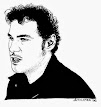
This and the next two posts show Charles Olson (1910-1970) in 1949 working through three takes on similar themes: the mythic foundations underpinning our everyday reality; the musical legacy of Modernism (form as rhythm, "my drum"); and the meaning (or meaninglessness?) of civilization in "the guilty present," in the aftermath of the Holocaust.

Like the Objectivists, his interests look backward to the high Modernism of figures like Pound, Eliot, Williams, and H.D. (the interest in periplum, the world from where I stand, a map made while moving; myth as reality's fundamental armature; form as an aspect of content rather than a tidy, predetermined metrical shape; history as "simultaneously present, i.e. the ancient as something available for use, not something we've progressed beyond, like H.D.'s use of myth to understand WW II; the poem and page as a field of action, etc.); but also point forward to whatever that something after Modernism (literally Post-Modern) will be. What sense of that "something" do you get from these poems?

La Chute

my drum, hollowed out thru the thin slit,
carved from the cedar wood, the base I took
when the tree was felled

o my lute, wrought from the tree's crown

my drum, whose lustiness
was not to be resisted

my lute,
from whose pulsations
not one could turn away

They
are where the dead are, my drum fell
where the dead are, who
will bring it up, my lute
who will bring it up where it fell in the face of them
where they are, where my lute and drum have fallen?

--Charles Olson (1910-1970), May 1949

Thursday, April 06, 2006

Northern California Book Awards

Hi everyone,

Yesterday evening I attended the Northern California Book Awards sponsored by Poetry Flash. It was exciting. Like the Oscars of Nor Cal literature.

Brian Turner's book Here, Bullet won for best book of poetry. The poems are based on some of his combat experiences and he read a few of them.

The most exciting part of the night for me was hearing Diane diPrima speak and read. She was honored with the Fred Cody (of our very own Cody's bookstore) Lifetime Achievement Award. The audience gave her a standing o, and she was witty and moving. Spoke of some of her own heroes and friends like Ezra Pound, "Larry" Ferlinghetti, and Audre Lorde. The poem she read was "Rant."

I would have posted about this event beforehand, but found out about it at the last minute. Keep an eye out for these awards next year. It's a free event, and pretty fun. Lots of books for sale and authors sign them too.

lw

Wednesday, April 05, 2006

Audible Oppen

Here's the link to the Oppen reading that I promised. 20 minutes of the entire Of Being Numerous. It's really a great book. Listen.

Tuesday, April 04, 2006

Zukofsky and Oppen

Did anyone see a similarity between Zukofsky’s A-2 and H.D.’s “Sea Garden?” After reading the poem, I was able to draw a somewhat unexpected parallel (maybe it was abstract) between some of his imagery and language in this poem and several of the floral/fauna images H.D. uses in her work. The fourth stanza read so musically and I loved the lines: “The music is in the flower / Leaf around leaf ranged around the center; / Profuse but clear outer leaf breaking on space / There is space to step to the central heart” (7). I found A-2 to be the most musical of his poems; the others seemed a bit more controlled, so that spontaneous quality was subdued. I also really liked Oppen’s “Of Being Numerous.” It read like a wonderful reflection on so many interesting possibilities, and at times, it seemed to take off in many tangents (corporate vs. spontaneous, emotion vs. intellect, the pulse of the metropolis). I suppose all of those possibilities are reflected as tangential offshoots of the title – numerous options in a varied world.

Ezra in Pictures

Slightly off topic, since we're meant to be thinking about Objectivists, but, here again, all roads seem to lead to Ezra Pound. Which had me wondering what Pound looked like. Many of you may have already seen loads of pictures of Pound, so apologies if the following images are commonplace. I found Pound to look suitably crazy! Following are pics of a young Pound, an old Pound, and Pound being arrested in 1945 by Italian separatists (classic "booking" photo!).


Sunday, April 02, 2006

[B] 1 0 [G]

To help yr reading (a preface to nonsense):

From Listening to Reading by Stephen Ratcliffe:

“the sound of a poem’s words and their visual shape on the page are interconnected: that the sounds of words is, literally, an acoustic shape (the shape of words in air), their shape literally a visual sound (letters waiting to become sound)”
…

“What happens when the words of a poem are put into the air by a voice or voices intoning syllables at certain precisely measured pitches held certain precisely indicated durations? And how is it that when the words of a poem are sung the result in its effect is more than either of its constituent components, its words, its music?”
…

“The music makes adjustment to our perception of text, what we think we hear when we read those words.”


………………

Please leave yr inhibitions at home on Tuesday (for a variety of both legal & not-so-legal methods to this effect feel free to contact me)

Yeder mensch hot zeiner aigeneh meshugahss … er bolbet narishkeiten.

Pop quiz: who #@$**^ -- or hangs to the left???

Really... Jeff and I aren't going to spend much time on bios this week since you can just as easily do that on your own. And check it out, juicy...

But--here is a pic of Oppen, that little rich boy, just because he looks so all-American football playerish its funny:


And, yes, we're serious. You must bring your instruments, of any sort, out of tune or not, whether you know how to play them "properly" or not. If you don't bring one you may be forced to play a baby piano or a maraca shaped liked a bumble bee. Or worse, you may have to make embarrassing noises with your mouth, or sing.

Saturday, April 01, 2006

question

How many people in class play a musical instrument? Seriously. If there are enough 'yes' answers this will make sense ...

Wednesday, March 29, 2006

Lorine, Lorine, the Thirties Machine

San Francisco's own Rumor Books, edited by Steve Dickison from the SFSU Poetry Center, recently published Niedecker's New Goose poems, a series she wrote from 1935 to 1945 based loosely on nursery rhymes, but filled with all sorts of sharp political and social comment.

The first poem in the series strikes me as a great illustration of that shift in tone that comes with the Thirties, modernist wineskins for socialist wine. Kind of takes as its subject too Williams's idea about the intimate connection between speech forms and social structures. What do you think?


A country's economics sick
affects its people's speech.

No bread and cheese and strawberries
I have no pay, they say.

Till in revolution rises
the strength to change

the undigestible phrase.


Nice essay on Niedecker for the interested here.

1931

That’s the one date you need to remember for next week’s poets, the Objectivists. It was the Feb. 1931 issue of Poetry (maybe the last memorable one??) that contained Zukofsky’s selection of poems by George Oppen, Charles Reznikoff and Carl Rakosi, among others, under the title ‘Objectivists 1931.’ All the poets were relatively young and virtually unknown. Pound (again!) had arranged for Zukofsky to edit the issue (Zukofsky had begun writing Pound soon after his graduation from Columbia), and editor Harriet Monroe insisted on a name for the group, which Zukofsky coined almost as a joke. Lorine
Niedecker somehow got the issue in Wisconsin and began corresponding with Zukofsky, from which all sorts of goodness and trouble flowed.

So … Feb. 1931.

Then they promptly fell into silence or neglect until the 1960s, when they got a second life. (Oppen and Rakosi spent their last decades here in San Francisco.)

So … hang in there.

Monday, March 27, 2006

Geek Alert

KQED Channel 9 is showing a documentary on Eugene O'Neill tonight at 10 p.m. It's by Ken Burns's brother Ric, which makes me kind of nervous. But O'Neill's so right smack dab in the middle of the revolution in words we're studying this term--b. 1888; debut play staged in Greenwich Village in 1916; comes to first fame in the heady experimentalism of the 1920s--that it'd have to be in Esperanto or something not to be worthwhile. And maybe even then ...

In 1937, O'Neill moved to Danville, CA of all places, and his house there--Tao House--is now a National Historic Site. Anyone been?

Friday, March 24, 2006

WCW on Mina Loy


"Mina was very English, very skittish, an evasive, long-limbed woman too smart to involve herself, after a first disastrous marriage, with any of us--though she was friendly and had written some attractive verse. I remember her comment on one of [Alfred] Kreymborg's books, Mushrooms--something to the effect that you couldn't expect a woman to take a couch full merely of pink and blue cushions too seriously. But when the Provincetown Players [best remembered for their association with the plays of Eugene O'Neill] has accepted Kreymborg's play, Mina had consented to take the lead. I was to play opposite her."

Which he did, convincing many on the Greenwich Village scene who saw it that he was half in love with Loy.

WCW on Marianne Moore

From WCW, Spring and All (1923):

"...I believe in the main that Marianne Moore is of all American writers most constantly a poet--not because her lines are invariably full of imagery they are not, they are often diagrammatically informative, and not because she clips her work into certain shapes--her pieces are without meter most often--but I believe she is most constantly a poet in her work because the purpose of her work is invariably from the source from which poetry starts--that it is constantly from the purpose of poetry. And that it actually possesses this characteristic, as of that origin, to a more distinguishable degree when it eschews verse rhythms than when it does not. It has the purpose of poetry written into it and therefore it is poetry."

From The Autobiography (1951):

"Marianne Moore, like a rafter holding up the superstructure of our uncompleted building, a caryatid, her red hair plaited and wound twice about the fine skull, though she was surely one of the main supports of the new order, was no luckier than the rest of us. One night (Mina Loy was there also) we all met at some Dutch-treat party in a cheap restaurant on West Fifteenth Street or thereabouts. There must have been twenty of us. Marianne, with her sidelong laugh and shake of the head, quite childlike and overt, was in awed admiration of Mina's long-legged charms. Such things were in our best tradition. Marianne was our saint--if we had one--in whom we all instinctively felt our purpose come together to form a stream. Everyone loved her."

WCW on H.D.

WCW remembering a turn-of-the-century afternoon walk with H.D., when she was still Hilda Doolittle and Pound and WCW were undergraduates at Penn:

"As we went went along--talking of what?--I could see that we were in for a storm and suggested that we turn back.

Ha!

She asked me if when I started to write I had to have my desk neat and everything in its place, if I had to prepare the paraphernalia, or if I just sat down and wrote.

I said I liked to have things neat.

Ha, ha!

She said that when she wrote it was a great help, she thought and practised it, if taking some ink on her pen, she'd splash it on her clothes to give her a feeling of freedom and indifference toward the mere means of the writing.

Well--if you like it.

There were some thunderclaps to the west and I could see that it really was going to rain damned soon and hard. We were at the brink of a grassy pasture facing west, quite in the open, and the wind preceding the storm was in our faces. Of course, it was her party and I went along with her.

Instead of running or even walking toward a tree Hilda sat down in the grass at the edge of a hill and let it come.

"Come, beautiful rain," she said, holding out her arms. "Beautiful rain, welcome."

And I behind her not inclined to join in her mood. And let me tell you it rained, plenty. It didn't improve her beauty or my opinion of her--but I had to admire her if that's what she wanted."

--from The Autobiography (1951)

WCW on TSE


from WCW, The Autobiography (1951):

"These were the years [Greenwich Village in the Teens] just before the great catastrophe to our letters--the appearance of T.S. Eliot's The Waste Land. There was heat in us, a core and a drive that was gathering headway upon the theme of a rediscovery of a primary impetus, the elementary principle of all art, in the local conditions. Our work staggered to a halt for a moment under the blast of Eliot's genius which gave the poem back to the academics. We did not know how to answer him."

Thursday, March 23, 2006

Williams on Pound, The Rematch

I found a really tiny image of Pound and Williams standing next to each other in old age that I was going to include here. But you couldn't really see it so why slow down the load time? Insert [Poignant Image(tm)] here.

Here's an excerpt about Pound from Williams's sequence “A Folded Skyscraper” (1927):

“…thinking of Ezra Pound, our greatest and rightest poet, how excellent he is in his self-deception—opposed with a laugh to my fervent, my fierce, anger to have a country—speaking of his work, deriding me, saying that in the end his artificial pearl will be longer to last than anything I have made with all my striving—writing the greatest American poems today, his pearl-like cantos, so purely American—his self-deception, thinking how right he is in his self-deception that he had found poetry in the quattro cento in Dante, in them all of those old countries—when as a fact he had found poetry—how right he is a United States poet—when he thinks he has found poetry in the Renaissance, in his self-deception—for he HAS found poetry, an artificial pearly Pound, exile,--he has welded his material, he has what he has discovered, he has taken what there at least is—driven from my country that I strive so wildly to possess, he has taken the false, the make shift—the thing that they have here—made him take—not the thing I want, but the thing I want.—it is poetry, it is United States poetry—but he is deceived in thinking the medieval is the poetry, he is the making of the poetry, it is artificial pearly poetry because it is driven from being MY poetry—still I am right and still he is righter than I and still what I see exists and still he is right in doing poetry out of what is left—and still he is self-deceived—thinking of these things.”

Tuesday, March 21, 2006

Williams on Pound


I don’t know what to do with myself without our class meeting tonight. Thought I’d fill up the time by posting some of William Carlos Williams’s reflections on his contemporaries. They’re helpful for locating him in his world, but they’re also just fun and kind of gossipy—perfect for spring break!

From WCW’s autobiography, called (um) The Autobiography (1951), remembering Pound as an undergrad at Penn:

“Ezra never explained or joked about his writing as I might have done, but was always cryptic, unwavering and serious in his attitude toward it. He joked, crudely, about anything but that. I was fascinated by the man. He was the liveliest, most intelligent and unexplainable thing I’d ever seen, and the most fun—except for his often painful self-consciousness and his coughing laugh. As an occasional companion over the years he was delightful, but one did not want to see him often or for any length of time. Usually I got fed to the gills with him after a few days. He, too, with me, I have no doubt.”

“I could never take him as a steady diet. Never. He was often brilliant but an ass. But I never (so long as I kept him away) got tired of him, or, for a fact, ceased to love him. He had to be loved, even if he kicked you in the teeth for it (but that he never did); he looked as if he might, but he was, at heart, much too gentle, much too good a friend for that. And he had, at bottom, an inexhaustible patience, an infinite depth of human imagination and sympathy. Vicious, catty at times, neglectful, if he trusted you not to mind, but warm and devoted—funny too, as I have said. We hunted, to some extent at least, together, and not each other.”